

Ramadan in Jerusalem brings up countless memories to my mind. That, doesn’t begin with the rhythmic beat of the “Musaharati’s” (pre-dawn caller) drum announcing “Suhoor” (pre-dawn meal), nor does it end with the seen of the row of people lined up outside “Al-Arz” shop to buy “Qatayef” (a traditional Ramadan dessert) in the late afternoon hours. In between dawn and evening, I can still recall simple, yet profound stories. One of those is that related to “Um Khalil”, our neighbor.
“Um Khalil” and my mom shared a bond that began years before I was born; a friendship that lasted nearly a decade beyond that. It wasn’t until that year when Um Khalil, well into her eighties, peacefully passed away, that their long journey together came to an end.
I got to know the Hajjeh (pilgrim Um Khalil) in my early childhood when my mother used to take me along on visits to her. She was devout, never missing a single prayer, but to her, faith was never just about fasting or rituals. In her view, religion remained incomplete as long as a believer’s compass wasn’t guided by morality, honesty, and integrity.
Every time Um Khalil prepared the delicious “Akoub” dish (Gundelia) during the “holy month”, she insisted on inviting us to “Iftar”, (break the fast) with her and her two daughters, who were in their thirties at the time. Gratitude to Um Khalil, who introduced us to “Akoub”. “Akoub” was quite rare in Palestine back then. Not to mention that preparing it before cooking was not easy as it has a lot of thorns that need to be removed. It was a complicated pre-cooking process and required a lot of time and effort.
Despite the age difference between Um Khalil and me, I was always more excited about her invitation than my mother. Perhaps, it was because I saw in her kind face the image of a loving grandmother, showering her grandchildren with affection and care. I would sit beside her when it was time to break the fast, and she would gently try to sneak the spoon of rice and yogurt into my small mouth.
Um Khalil’s health wasn’t in the best condition due to her old age. Her movement WAS slow and heavy. The burdens and complexities of life during that time were many. Despite all this, prayer time was sacred to her. She would rise from her seat, lean on her wooden cane, politely excuse herself from her guests, and quietly retreat to her room for a few minutes to perform her prayer. Then, she would return and sit with us again. Each time before she began her prayer, she would playfully ask me if I wanted to join her in the room and pray beside her. Without hesitation, I would immediately say, yes. She would bring me a long white skirt and a headscarf, and I would stand and “pray” next to her.
Praying beside Um Khalil, as a child not yet five, felt like an exciting, exploratory adventure. I didn’t understand the quiet words she whispered during prayer, but I was determined to mimic every movement, whether it was a nod of the head, a gesture of her hands, or the way her lips moved. I’d stand, then bow, lean forward, and straighten up again. When I turned my head to the right, then to the left, I knew the prayer was almost coming to an end. She’d gently take my hand, and we’d return to the living room to catch up on the latest episode of a Ramadan series on the only Jordanian TV channel. We’d spend the evening in warmth and laughter before my mother and I made our way home. I’d slip into bed, falling into a deep sleep, ready to wake after midnight for yet another chapter of my Ramadan adventures, as the sound of the “Musaharati” grew closer, bit by bit.
Sometimes it was the rhythmic beat of his drum. Other times, it was his loud voice that echoed through the night, calling, “O sleeper, praise the eternal”. At first, his shouting would startle me, but that feeling quickly turned into excitement. I’d leap out of bed in the darkness, walk on my toes towards the window that overlooked the road. I’d gently pull back the curtain and wait eagerly for him to pass by. Once I caught sight of him, I considered my mission complete. I’d quietly slip back into my bed and fall into a peaceful sleep once again. The next morning I’d get out of bed with the same decision as the day before.
I am going to fast today in solidarity with my friends in the neighborhood. Day after day, I’d made the same promise, however, I failed. Just a few hours of fasting before the “birds in my stomach would start chirping” (proverb from Arabic” at noon demanding food. The feeling of hunger always defeated me. Sheepishly, I’d lower my head, “raise the white flag”, and give up. I’d rush into the kitchen where my Grandma, Um Hanna, spends most of her time. I’d ask for my two delicious eggs that she fries in ghee in her traditional Syrian way before rushing back again to the garden to play with my friends.
My grandmother’s house, on my father’s side, was just a few steps away from ours. During the summer holidays, I used to spend my mornings with her until my parents came back from work. As for my Grandpa, Abu Hanna, I never got the chance to meet him. I was told that he left this world just a week before I was born.

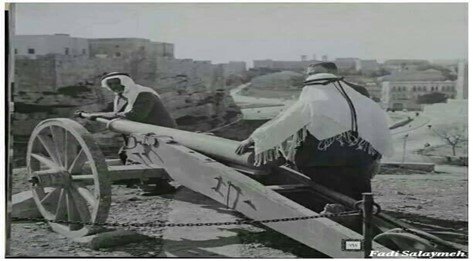
The Ramadan cannon at the Islamic cemetery on Salah al-Din Street in Jerusalem, a legacy over 120 years old, maintained by the Sandouqa family
Published on April 15, 2021
