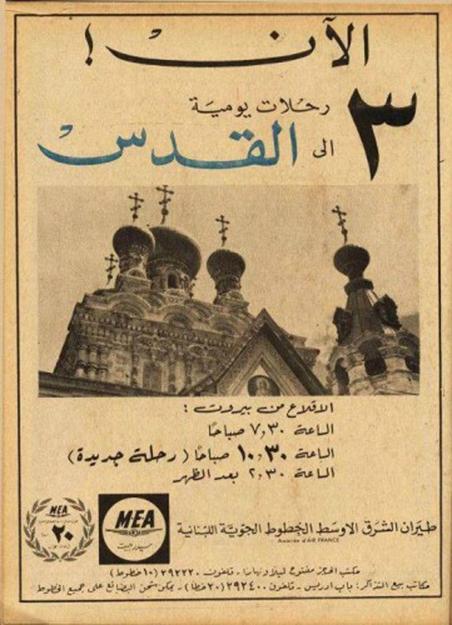


Lebanese Airlines’ weekly flight schedule from Beirut to Jerusalem
In those days, the world was not a “small village” like today. It was more of distant, isolated “village-like” continents where each was not aware of what was happening in the other neighboring one. Consumer culture was not yet widely spread as nowadays. Globalization had not yet woven its way into the simple, though harder, lifestyle of the people. The passion for travel, exploration, and discovering new places beyond the homeland’s borders was not a priority.
Moreover, “home” felt like a whole world in one geographical spot with the diversity of its landscapes. A planet by itself full of mountains, plains, seas, rivers with purely four beautiful seasons, where in each one a special flower blooms. Visitors from far away would fly thousands of miles to come and see it. They wander around admiring the beauty of nature, even for few days sometimes. However, when one felt in need of a short escape away, one would quickly realize that the options were limited in accordance with the Arabic saying, “wind does not always blow in favor of our desires”.

Fairouz to Jerusalem, performing the hymn “The Sorrowful Mother” in preparation for Pope Paul VI’s visit in 1964

Pope Paul VI’s visit to Jerusalem in 1964, marked the first time the Supreme Pontiff traveled outside of Rome
After the “Year of Thunder”, everything changed. Traveling between the “brotherly” Arab countries has become difficult. It required complicated procedures. Sometimes, it was even impossible. Beyond these challenges, the deteriorating economic situation made it even less feasible. There were other priorities. It is not just about securing food, clothing, and shelter, nor simply about covering the expenses of education and healthcare. It also involved saving some money for a possible short summer trip to see those relatives who were displaced on the “other side”. Despite that the “other side” was just few kilometers away from its twin sister, however, reaching there felt like a “Via Dolorosa” for the Palestinians.
Meetings between family members were no longer easy after the “thunder year”, 1967 war. The land was split into two “sides”, the West Bank”, the occupied Palestinian territories, and the “Eastern Bank”, the Jordanian Hashemite Kingdom. The “first” was under the guardianship of the “second” until the June 1967 war. Since then, it was occupied by “Israel”.
A bridge now separates the “two Banks”; the one that the “Rahbani brothers”, (Lebanese composers) called in one of Feiruz’s songs, “Jisr Al_Awda”, the Bridge of Return. The “Bridge” is still standing there, while the Return has not been fulfilled up till today.
Though the distance still seemed short in the eyes of both the Palestinians, original owners of the land and the Israelis, who occupied it, however, it increased day by day, year by year, and decade by decade. The hope of Palestinian families reuniting became more of a dream, if not a miracle. It required considerable effort and time, until the beginning of the nineties, before deciding to pack and get ready to go to the “Eastern Side”. Assuming that this first step mission has been accomplished, then comes stage two, where you should stand in a long queue under the sun before you are allowed to cross the bridge. The latter known as the King Hussein Bridge for Jordanians, and the “Allenby Bridge” as named later by the “Israelis”.

Though the trip was exhausting from A to Z, talking about it among the Palestinians was a long story itself.
Palestinians shared their happy and sad memories about it with each other. They told their children and grandchildren in detail what happened with them.
Some of the stories would raise the anger of the listener, particularly when describing the humiliation Palestinians faced, while others would make you laugh to death, as you watch the elderly recounting excitedly tales about the boxes of olive oil, cheese, and olives they carried on their heads and took with them to their beloved ones at “the other side.”
For them, those were precious gifts that “has the scent of homeland” as they used always to say. They repeatedly described proudly their victories over the Israeli soldiers at the crossing as they managed to prevent them, partially, from confiscating all the oil they had after “spilling” some of it on the ground right before their eyes; They spoke of that young blonde female Israeli soldier who “looted” the sweets they had brought as gifts for their families, friends, and neighbors; fearing they might have hidden some explosives under it.

The late King Hussein bin Talal of Jordan lights a cigarette for the late former Prime Minister Yitzhak Rabin after the signing of the Wadi Araba Treaty in 1994
For the Jerusalemites, going to the “other side” required specific procedures. Like the rest of the Palestinians in other parts of the West Bank, they were issued a Jordanian passport that was renewed every two years. Going to the Eastern Bank, to Jordan, required obtaining an Israeli travel document called “Laissez-passer” from the Israeli “Ministry of Interior”, located on Nablus Street in East Jerusalem. A clerk working for the Ministry would fill out the required application on his typewriter outside the building for them, in exchange for a few coins. Then, the applicant would submit the form in person inside the building.

The road to the King Hussein Bridge through Jericho (Allenby Bridge), designated for holders of Jerusalem IDs
The follow-up review would be scheduled after two weeks at best. A tentative appointment without specifying an exact date and hour is “scheduled”, and this does not necessarily mean that the “Laissez-passer” will be in the applicant’s pocket by the end of that period. In many cases, particularly for young people, they may be asked to return multiple times under various pretexts, such as claiming that the documents are incomplete; the attached photo does not match the applicant’s actual appearance, or the “security record” is not “clean” and requires further investigation.
Getting ready to travel from the West Bank to the East Bank was not only limited to considering the Israeli requirements for crossing the “Bridge of Return”. In order that one can pass the Jordanian side, one had to be sure not to carry a single piece of clothing which holds a label with Hebrew letters. This was enough to forbid one from crossing the other side.
The task of removing the labels was usually of my mom. Every summer when we decided to head to the East Bank to visit my aunt, her older sister, who settled in Jordan since 1967, she would gather the clothes around her on the bed and start checking each piece before arranging it in the bag.
I would sit beside her on the bed. I watch and offer help. She would stay late at night, inspecting our clothes before packing the suitcase. She would mutter under her breath, praying for an easy journey ahead.
In a whisper, she would wonder whether the trip would be complicated and would take forever, or easy and quick. She was longing to see her sister, but at the same time afraid of not being able to make it for some silly reason or another. However, after her “dream” of reuniting came true, she was full of joy even though she realized that exile was now a fact and reunification was only temporary.
We would spend a month at my aunt’s modest home in Amman. We then head back to “our side” once again. We pass the same “Via Dolorosa” carrying with us the most beautiful memories and the funniest stories. Not a single day would pass after coming back without seeing my mother dusting off carefully the set of Chinese coffee cups which she wrapped in layers of old newspaper and brought with her from the “other bank”. I still remember how she always was afraid it might break.
The Chinese set stood there safely in the cupboard for years on, only to be used on special occasions and to bring back memories of those summer trips.
Published on April 22, 2021
