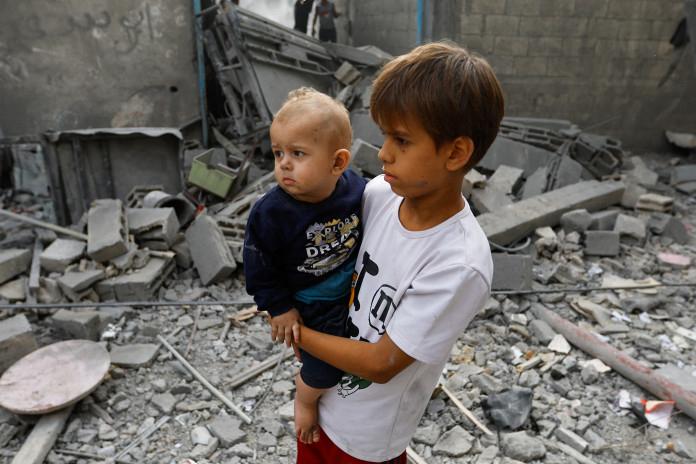


My day begins with my son’s cry, marking his morning feeding of 150 ml of milk. He wakes up the moment hunger strikes, a natural human instinct forgotten by modern habits. This war strips humanity to its core, reverting people to their primal state. From 6 AM to 8 AM, I spend precious moments playing and bonding with him.
During these early hours, everyone is preoccupied with securing potable water and water for household and bathing needs. Our primary water source is a neighbor’s well, while solar cells provide limited electricity for lighting, charging phones, and accessing the internet.
At 8:30, I set off for work. Displaced to the western part of Al-Zawaida near the sea, my commute lasts 40 minutes. I walk 500 meters, then wait for a donkey-drawn cart to take me 3 kilometers to Deir al-Balah Souk, where I switch carts for the final leg to my workplace.
The donkey cart drivers have remarkably organized their routes, ferrying people for a fare of 2 shekels per ride, though the journey is long and unbearably hot. Cars are impractical due to the prohibitive cost of diesel as the cost of one liter is 120 shekels.
Though I enjoy walking, the streets, polluted with raw sewage, make it impossible. Hepatitis is rampant in Gaza, making avoidance of sewage essential.
Hundreds of tents, now brown from nine months of being set up, line the road. These shelters of wood and cloth are barely sufficient for sleeping. Inside, they are mostly women managing food storage and preparation, while men construct rudimentary toilets if they can afford it. These wooden toilets with cloth doors are connected to pits; without pits, waste is discarded directly into the street.
Those who can’t afford such toilets use plastic bags, bottles, or containers.
The temperature inside the tents is at least 5 degrees higher than outside. It is exceeding 36 degree Celsius with high humidity. when you look at Gaza on a world map, you see it as a city on the sea, between a large desert stretching from Sinai to Al-Naqab. Thus, it is essentially a desert city.
People sweat profusely inside the tents as conditions are unbearable. Women often sit in any available shade outside the tents. The “prayer dress” has become essential attire for its coverage and quick wear in emergencies.
Water scarcity is a daily challenge. People scramble to fill containers from water trucks; missing the truck means going thirsty!
Most people I encounter on the 40-minute donkey cart ride have lost significant weight, likely around 10 kilograms each.
Donkey cart drivers and vendors irrationally refuse any currency that isn’t brand new, even rejecting banknotes of 100 and 200 shekels unless they are new.
Passing Al-Zawaida, reaching Dair Al-Balah cemetery, I see people digging graves for those killed the previous night. These graves are dug primitively, often for entire families, with victims buried together, separated by dividers for males and females, and young children placed in their mothers’ arms.
If the family had someone who died years ago, they open the old grave, move the decomposed bones, and place the new dead beside them.
In the west of Deir al-Balah Souk, drugs are openly sold. To the east is the cigarette Souk, where regular cigarettes are sold at 30 shekels per centimeter, and cheaper cigarettes, made of herbs and a little tobacco wrapped in children’s drawing paper, are sold for 7 shekels each. Drawing books have become valuable commodities for tobacco addicts.
The Gaza war has definitively proven that tobacco is an addiction, not just a habit.
Near the cigarette Souk is the thieves’ Souk, selling everything from water tanks to your personal phone. Stalls line the street, offering goods at exorbitant prices. Many vendors are tent residents, obtaining goods from traders or selling their humanitarian aid.
With Deir al-Balah’s population swelling to over 700,000, tensions between residents and the displaced are palpable due to the lack of order.
The displaced community is governed by customary laws enforced by power, allowing individuals to do as they please if they can assert authority.
Security personnel in the Souks are ineffective, though they occasionally show force.
In the Souk area, I had to take another donkey cart. Near the vocational training center, now a shelter for the displaced, century-old cypress trees have been cut down for firewood.
Reaching work, the day’s struggle begins anew. Internet outages render work futile until service resumes.
The day can be abruptly disrupted by sudden invasions or bombings. Recently, a house was bombed as I returned from work, killing 11 people. The occupation forces now use missiles that strip houses of their walls, leaving structures standing – the reason why people call it “stripped houses.” Bodies are flung into the streets after the bombing with people gathering their neighbors’ remains.
People are irritable and sensitive, feeling deeply wronged. Simple words can easily hurt their feelings, reflecting Gaza’s dire state and the simplicity of their demands amidst the catastrophe.
Thank you Maram AL-Ghoul for the translation
Abdallah Sharsharah
July18, 2024
